
© Jeanne Vienne
Gauvain Leconte-Chevillard
Researcher in history and philosophy of cosmology
Philosophy instructorORCID iD: 0000-0002-3066-2326
About

I am currently a postdoctoral researcher at the University of Namur after ten years of teaching in secondary education and completing a PhD at Paris Panthéon-Sorbonne University on predictive success in empirical sciences.
My main area of research is general philosophy of science, particularly the history and philosophy of cosmology.I have also worked on theory of definition, game studies, and methodologies for teaching philosophy.
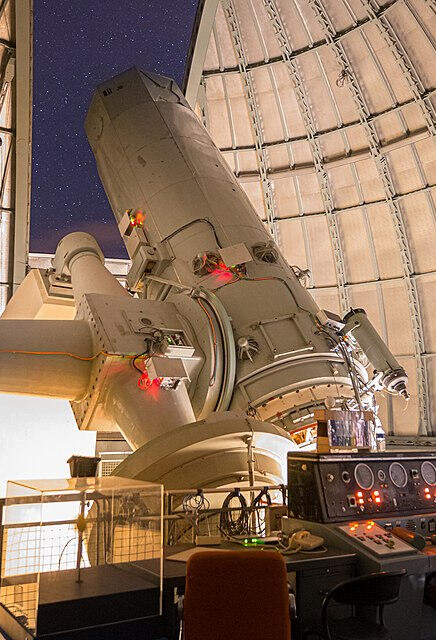
Instrument T193, which detected the first exoplanet, at the Observatoire de Haute-Provence - where I got the chance to do an internship. Photo by José Rodrigues, CC BY.
Some examples of my research topicsCan experiments be conducted on the scale of the entire Universe?
See here and hereIs a theory that makes accurate and surprising predictions necessarily true?
See here and hereCan you cheat in a video game like you can in other games?
See here

The Supernova Requiem appeared at different times in different images of the gravitational lens MACSJ0138. Measuring this time delay is used to calculate the Hubble constant, the current rate of expansion of the Universe. NASA, CC BY.
I speak and read French and English fluently. I can read German but I'm not fluent in speaking it. On the other hand, I can't read Japanese, but I came back from a semester abroad at Nagoya University with some conversational skills in the language and a fascination for the familiar strangeness of Japanese culture.
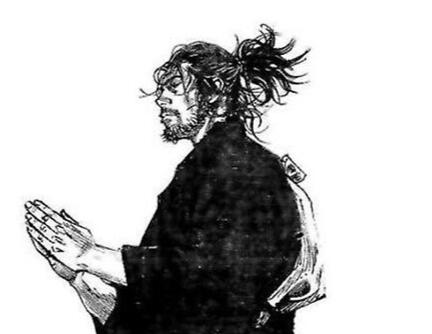
Miyamoto Musashi, by Takehiko Inoue, CC BY
There are many other subjects that fascinate me — comic books, theatre, basketball, very long train journeys, drawing and linocut, animal behaviour, the history of social movements, and cave art — but I don't write about them (at least not yet).
I actively support every movement for equality in all shapes and forms.
Livres
Prédire. Essai sur un succès scientifique, éditions Matériologiques, 2025.
This essay examines how scientists make predictions, what can be gleaned from them to confirm theories, separate fact from fiction, anticipate experiments, and counteract the manufacture of ignorance. French only

Histoire d'une science impossible, éditions de la Sorbonne, 2023.
Marc-Auguste Pictet Prize from the Geneva Physics Society.
Available in Open Edition here.
This historical monograph details the philosophical controversies between cosmologists on the knowledge of the Universe since the dawn of relativistic cosmology. French only but a draft translation of Chapter 4 on the theory of inflation can be downloaded here.

Articles
🪐history and philosophy of cosmology
⚛ general philosophy of science (theory of confirmation, scientific realism, social epistemology)
🎮 game studies
🇬🇧🪐⚛ "The Poor Man’s Accelerator’, or how Cosmology Became the Testing Ground for Particle Physics” Synthese 207.3: 89. 2026. Preprint⚛ “What a Powerful World: Dispositional properties as the best description of the fundamental elements of physical reality”, co-authored with Andrea Roselli, Synthese 207.3: 91. 2026. Preprint🪐⚛“Experimentation in Cosmology: Intervening on the Whole Universe”, Studies in History and Philosophy of Science, volume 106, p.136-145. 2024.Preprint🪐⚛ “Experimentation in the Cosmic Laboratory” in Studies in History and Philosophy of Science Part A, volume 90, n°9, p.265-274. 2021. Preprint🪐⚛ “Predictive Success, Partial Truth and Duhemian Realism”, Synthese, 194:9. 2017. Preprint⚛ “The Predictive Capacity of Biological Theories”, in Proceedings of the CAPE International Workshops, 2012, ed H. Nakao , CAPE Publications, Kyoto, p.60-68. 2013.
🇫🇷
🪐⚛ « Des inductions dans l’Univers : quel principe d’uniformité utilise-t-on en cosmologie ? », La Métaphysique de l’induction, ed. J. Tricard, Éditions Hermann, Paris, 2026.⚛« Doutes sceptiques sur certains projets de métaphysique naturalisée », Métaphysique et sciences ed. F. Papale, Éditions Matériologiques. 2026.🪐⚛ « Une science du multivers est-elle possible ? Structure et fécondité des raisonnements anthropiques », Connaître le cosmos, eds J. Bernard et S. Beyne, Éditions Spartacus. 2025.🎮« Donjons et jardins : narration par le level design dans le jeu vidéo », Mondes virtuels et jeux vidéo, eds M. Buthaud et F. Varenne, Éditions Matériologiques, Paris. 2024.⚛ « Sciences et vérité », Que peut-on enseigner de la vérité ?, eds S. Roux et E. Nal, Presses Universitaires de Rennes. 2023.🪐 « Cosmologie » (article avancé), Encyclopédie Philosophique. 2021.⚛🎮« Théorie de la définition et jeux vidéo : règles et lois dans l’expérience vidéoludique » Sciences du jeu, n°11. Open Access. 2019.🪐« Expliquer et prédire dans le multivers », co-authored with Julien Grain, L'Exercice de la pluralité des mondes, eds. S. Nony & A. Sarrieau, ADAPT Éditions, pp. 135–148. 2017.🪐« Cosmologie » (article grand public), Encyclopédie Philosophique. 2017.⚛ « Prédiction scientifique » (article avancé), Encyclopédie Philosophique. 2016.
Forthcoming or in progress🪐⚛ "Did the Standard Interactions Emerge at t = 10−32 s? Inflation, Reheating and Particle Creation in the Very Early Universe", co-authored with Simon Cléry et Andrea Roselli. Draft⚛ "Gods and Demons: When Causation and Emergence Part Ways", co-authored with Andrea Roselli. Draft🪐⚛ Sauver les phénomènes, sauver les théories: histoire et épistémologie des modèles phénoménologiques dans les sciences du ciel, manuscript co-authored with Julien Bernard et Théo SimonIf you can't access some of these texts, don't hesitate to contact me: [email protected]
Media
📻Podcast with cosmologist Françoise Combes. Soirées Philosophie, Science et Société à la Sorbonne: « Astronomie : Matière noire, énergie sombre, ultimes mystères de l'Univers ? », November 2025.
French only📻Podcast with cosmologist Pasquier Noterdaeme. Soirées Philosophie, Science et Société à la Sorbonne: « Astronomie : connaître l’Univers, une science impossible ? », November 2025.
French only📻France Culture, La Science Chrono, interview by Antoine Beauchamp, « Georges Lemaître : quand l’Univers fit boum ! ». April 2024.
French only▶️A-t-on besoin d'un principe d'induction en cosmologie? Talk at the conference Métaphysique de l'induction, June 2022, Paris.
French only▶️Histoire d'une Science Impossible. Talk at the conference Philosophie et Cosmologie, December 2019, Marseille.
French only
Teaching
Here are some educational activities that I have designed and which can be shared freely!
Cosmology and Philosophy of Science.
Introduction to the philosophy of science for astronomy students using real cases from the history of cosmology.
Document
French only
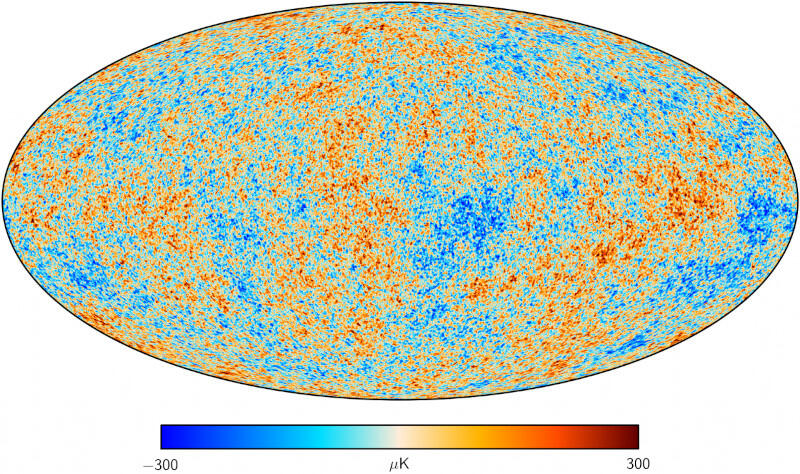
Anisotropies of the CMB, Planck mission, CC BY
On the usefulness of turkeys and polar bears in teaching the philosophy of science
Published in the practical guide Enseigner la philosophie, available here, this lesson plan offers a few tips for a dynamic and engaging introduction to the philosophy of science for all audiences.
Original document in French
English Translation

The Trial of Galileo
An adaptation of Nicole Grataloup's "philosophers' symposia". What would happen if we had a time machine to bring scholars and philosophers from all eras to testify at Galileo's trial in 1632?
An active method for developing philosophical skills and discovering a famous episode in the history of science.
Document 1 et Document 2 French only

Galileo's telescope
Test: Which philosophical concept of happiness suits you best?
Some philosophers believe that happiness is an ‘undefinable' concept. But according to others, genuine happiness has necessary ingredients. Whether it's pleasure or duty, this short test can be filled by anyone who want to know which philosophical ideal of happiness best suits their private inclinations.
Original document in French
English translation

Emilie du Châtelet, by Marianne Loir, CC BY
CV

© UNamur
Full academic CV.I studied philosophy at the École Normale Supérieure de Lyon, a highly selective French institution that trains researchers and teachers. Students at the ENS are civil servants in training and commit to several years of public service. In my case, this took the form of ten years teaching philosophy in French high schools, mainly to final-year students preparing for the national baccalauréat examination. I have also taught in a variety of other contexts, including undergraduate and graduate university programs, a pilot program combining mathematics and philosophy, classes for newly arrived non-French-speaking students, and courses in prison.I am a tenured secondary-school teacher in philosophy (having passed the highly competitive French national examination, the agrégation de philosophie) and I am qualified for assistant professorships in France by the National Council of Universities (CNU) in both Philosophy and History and Philosophy of Science. I am also an associated researcher at the Institute for the History and Philosophy of Science and Technology (IHPST) in Paris.I hold a PhD in Philosophy from Paris 1 Panthéon-Sorbonne University and two university diplomas from the Paris Observatory, where I teach an annual introductory course in philosophy of science.I'm currently a postdoc of the MIS project supervised by Prof. Olivier Sartenaer of the University of Namur "Re-engineering non-reductive physicalism for the 21st century". My role is to find and analyze cases of diachronic emergence in philosophy of physics, and especially in primordial cosmology.I am vegetarian, but some says that I can make a decent steak tartare - only because I inherited my grandmother's recipe though.AwardsIn 2018, my PhD dissertation was awarded the Aguirre-Basualdo Prize of the Chancellerie des Universités de Paris and the Doctoral Dissertation Prize of the Université Paris 1 Panthéon-Sorbonne.
In 2023, my book Histoire d'une science impossible received the Marc-Auguste Pictet Prize awarded by the Société de physique of Geneva.